Sunday, July 18, 2010

Comings and goings

The week offered quite a variety of activity and visits to three other DRF locations, visitors coming and going, volunteers heading back to Canada for holidays and colleagues returning to engage in new endeavours.

The youth programme in Kingston was focused on preparing for summer camp and my work was directed in different directions. On Monday, with the assistance of another volunteer, I completed a proposal to expand the number of Peace and Justice Centres in the troubled communities across the island and providing an accessible unit cost framework. It was positively received by the Ministry to which it was submitted and immediately generated a letter of support to the funding body which is very encouraging, though a long way from a funding commitment. Then I headed out on the road with others to visit the youth programme in May Pen, Spanish Town and Montego Bay. We installed a new database developed by a volunteer a few months ago and met with the staff.

In Spanish Town the computer cafe was being actively used by a number of adolescents and the youth peace facilitator was dividing his time between the small number of youth attending the suspension programme, those using the computer centre and a group of enthusiastic young volunteers helping put the final touches to the summer camp plan. The plan looks great with the only stumbling block being the one typical of here - where will we find the very modest funds required?


In Flanker, Montego Bay we were greeted by lots of children already involved in summer activities. the Flanker Peace and Justice Centre is invariably a hive of activity and has made a tremendously positive impact on the community. It feels very much as if it is owned by the community and there are many local volunteers supporting the skeleton staff that operates the centre. They look forward to a church group from Miami visiting next week to run a summer camp for the second time. We then went into Montego Bay to the Peace and Justice Centre downtown which is looking much smarter than when we last visited with the addition of new desks, chairs, tables and computer equipment with support from DRF and CUSO-VSO, though again operating funding is a major issue.


It was wonderful to get out on the road and I am quickly reminded how much variety there is in this country. The drive is long, three and a half hours to cover the 180kms to Mo-bay, but quite lovely. As one winds ones way through the narrow mountain road there is no need to go hungry. Along the way the road is lined with fruit higglers and jerk centres. I was introduced to guinep on this drive, a fruit quite similar to lychee and deliciously juicy. Some other fruits available at the moment are jack fruit, pineapple, mango, apples, june plums, and of course the perennial bananas, papaya and oranges, all ready to be eaten as one travels the road! In addition there are many small stands that offer an even wider range of fruit and vegetables, as well as fresh fish stalls. Another illustration of the dichotomy of Jamaica - despite the poverty and hunger in the city it is indeed a land of plenty.

Thursday I was back in the city and meetings in Denham Town. The plans for summer camps and family days are coming together, though it requires much discussion and clarity about the boundaries and locations of events. It felt as if those involved are becoming weary and need a boost. It has been a very difficult few months and the complexity of making significant change is occasionally overwhelming. As is not unusual in community development the leadership and energy lies with a small group who have been working arduously to make sure the current crisis is experienced as the opportunity it also provides.There remains much mistrust, anger and grief in the communities and these take there toll on those working there.

One of the things that has become evident in my nine months here is the movement on an off the island both for short absences and long. It seems to be an integral part of Jamaican life from the adults that go to "foreign" to work, the students that go to "foreign" to university, the absent parents who live "foreign" , the professionals who take their education and their intellect and emigrate to the US, Canada or the UK, and those of us that come here for work or positions and move on and off regularly. It adds a transitory air that is not perhaps a positive element and I think may limit the emotional and real investment in the island. I think it might also contribute to the limited long-term vision and lack of accountability. On the other hand is also brings a sense of linkage to the rest of the world and an awareness of other countries and cultures that has a beneficial effect. It is a component of island life that I will give more thought to as it unquestionably has an impact, perhaps both positive and negative.

Next week will provide the opportunity to audit the International Institute of Restorative Practices Training for Trainers which is being provided to support the roll out of restorative practices by the Ministry of Justice in partnership with DRF. My hope is to get insight into what the trainers and the programme will need to ensure an effective long term implementation, a process that to date has not been afforded the attention it requires.

Sunday, July 11, 2010

Broadening my scope...

The week feels as if it has been full of opportunities, and consequently the time has disappeared. I am getting involved in a wider range of projects at DRF, becoming more involved in the community renewal process for West Kingston, met a group of volunteers - Students Crossing Borders - who have done some amazing work and had a lovely trip up to Ocho Rios on the weekend.

The increase in scope at work is in part as a result of the impact of May 24th and the continued focus on the garrison communities. The crime stats for June were an improvement though still extremely high, there are still large numbers of soldiers moving around placing one community or another on curfew. Curfew means you can only move in and out of the community if you have the correct I.D. and many do not, it also means the soldiers are entitled to search homes, cars and people as they choose. Given how intrusive and difficult this is I really hope it increases safety and in the long run contributes to things improving. My focus has been two-fold - one short term and one long term. The short term activity entails working with the West Kingston Working group to contribute to the co-ordination of summer camps.The long term is developing and writing a proposal to open or expand Peace and Justice Centres in four of the most trouble parishes as the government strives to find a means of re-establishing some level of trust and a means to establish non-violent methods of resolving disputes. The final draft of the proposal was sent to the CEO tonight (today was spent writing and calculating hence the late blog entry!)
It has been a catalyst to articulate a replicable model with a clear understanding of the capacity available and funding required. I think the model has good potential to help in proposals and expansions for a few years to come so feels as if it is a significant piece of work in our goal to increase the organisational capacity of DRF.


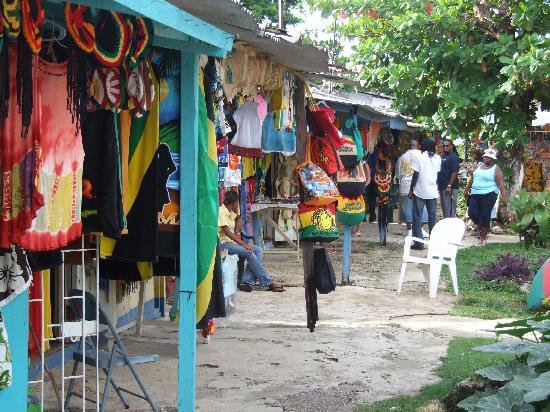
In addition to these activities I had the pleasure of seeing a friend from Kinark. She and her daughter are in Kingston for two weeks doing volunteer work with Students Crossing Borders. They are involved in work in schools and in centres that care for children with HIV/AIDS through an organisation called Mustard Seed Communities. The group welcomed me one evening for dinner and to share my experiences here and then invited me to join them for dinner yesterday at a great fish restaurant in Port Royal ( a favorite spot!) Dinner followed a day in which we had headed to the north coast to swim with dolphins (which we didn't do!) but did enjoy swimming in the Caribbean and the two visitors swam and snorkelled with the sting rays! We went north through Stoney Hill through the twisty, narrow mountain road that leads tiny villages, follows the river and ends as one drives through banana plantations as one reaches the coast road to Port Maria. The trip home was via the craft market in Ocho Rios where bargains were accomplished as well as a wonderful discussion with one of the vendors about how to change Jamaica. Once we left Ochos we drove through Fern Gully, which has not dulled in its magnificence despite many trips through. Two kilometres of deep green gully with steep stone wall, hanging vines and rain-forest lushness, a canopy that filters the sunlight creating a sense of mystery in the muted depth and then one emerges high in the mountain with the sun shining and the moutains and pastures stretching ahead. It was a lovely day and it has been such a pleasure to spend some time and talk of how things are in Ontario.
At the end of the evening I drove back from Port Royal round the Palisade and into Kingston. There was an army checkpoint on the road, though nothing unpleasant, it was another reminder that all is not yet well in Kingston.


Next week will bring more travel, to Spanish Town and Montego Bay and I hope one more opportunity to see the friend from Ontario.


(apologies for the lack of images but a glitch is interfering with the upload!)

Sunday, July 4, 2010

Community Development and Celebrations

This week has provided a broad range of activities at work which contributed to a busy, demanding and interesting week, but limited time and energy for other activity so a Kingston-based week. In addition to my role at the youth programme, I have joined the West Kingston Communities Working Group and the Steering Committee for a recently approved project "Young Man Nuh Lingah" targeting "corner youth" in 10 communities in 3 parishes.

The West Kingston Communities Working Group has a mandate to develop and implement a co-ordinated support and re-building process for the three communities most directly affected by the May 24th action. It includes a wide range of community-based organisations, non-governmental organisations and government agencies. The discussion ranged from strategising about how to deal with the depth of the trauma that has been identified through screening 400 school children to how to develop a template that can be applied across all the Garrison communities and communities of 'informal settlers" across the country, all this in an environment of economic constraint. There were a number of things that were striking to me in the meeting. One was the apparent surprise of those who completed the trauma screening at the depth of trauma identified through the screening and how many students are suffering from severe trauma. This was striking to me as it has been my experience that the majority of the students who are suspended and attend the Youth Programme demonstrate indications of severe trauma, and this not as a result of a single event but as a result of their exposure to the "usual" violence perpetrated in the Garrison communities. It is hard to imagine the gulf between "uptown" from where most of the psychologists analysing the screening come and "downtown" is so great that there is little understanding of what children and youth are facing daily in their communities.

Another thing that was striking was the use of language. Just as at a previous community meeting I had noted the use of the term "influential men" which seemed to sanitise the real role these men play in the community, two of the terms used in the meeting were "regularising" and "informal settlers". "Regularising" is applied to the action being taken by the Jamaica Public Service and the Ministry of Housing and Water to re-institute charges and billing for electricity, water and rent. One of the indicators of how powerful the gangster control was of Tivoli is that residents were not required to pay the government agencies for utilities and housing as the gangsters would not let the authorities into the community. As can be imagined "regularisition" is not necessarily a well supported activity! "Informal settlers" is the term applied to squatters. There are many abandoned buildings in downtown and many are utilised by squatters, in fact the history of the Garrisons is founded on squatters. Historically as a result of the migration from the countrylarge numbers of people looking for work in the city squatted on the grazing lands (Pens) around Kingston building shanty towns. This was how the communities were first populated and built. The term "informal settler" is used with much greater respect than is implied by "squatter" and appears to legitimise those who have been forced to find shelter this way. This was encouraging to hear. I learned a great deal and look forward to my continued involvement with the group as, despite the differences, there are many similarities across cultures and countries about developing integrated community responses and I am hopeful I may be able to offer a constructive contribution.

The "Young Man Nuh Lingah" project is a challenging project targetting the engagement of "corner youth" in 10 communities in three parishes - St Catherine, Clarendon and Kingston. "Corner youth" are the young people, predominantly young men, who are unoccupied and hang around in little groups on the corners. As one travels through the poor communities the sight of these groups is notable and there is often a somewhat threatening feel about them. They are typically young people who have left school with few skills and have no opportunity for legitimate gainful employment and are as such very vulnerable to being engaged in gangs and crime. The project has very limited funding, so again will depend on a co-operative effort between existing community service providers both formal and informal. It will provide me with the opportunity to be involved in a number of communities at the community level over the next few months and connect with young people who I would not get to meet through the school suspension programme.

As well as work there have been celebrations this week. In my travels through the city I have seen endless Graduation Celebrations. It seems every location that can accommodate an event has been utilised this week and as I walk past there are the sounds of applause; singing and music, speeches thanking teachers, parents and the young voices of Head Boys and Girls who will moving on to their next phase in life. The halls are full of students - girls dressed in gauze, taffeta, satin and silk, boys in crisply ironed shirts, ties, dark suits and shined shoes. Laughter and giggles, shuffling in the queues as they wait to receive well-deserved certificates and proud parents dressed formally and looking extremely proud. These are the students for whom the future holds some promise and on the day of their graduations they can enjoy the praise of the adults who have supported them so far and look forward to the possibilities ahead.

Of course the volunteers also had a reason to celebrate on Canada Day on Thursday. A couple of the more patriotic volunteers had contacted the High Commission to explore what was being planned, only to be told that due to financial constraints the celebrations this year would be limited to only Distinguished Guests and volunteers do not qualify! So people gathered to celebrate together and I would hazard it was probably much more fun than a formal gathering at the High Commission would have been. I walked home after our gathering as it was not late and the High Commission was shut up tight with no evidence of a celebration!

I had hoped to spend the rest of Sunday at the beach but the day is once again cloudy so I will explore the weather forecast before I venture out. The beginning of hurricane season has brought significantly more rain and cloud than I have yet experienced here. Next week I am looking forward to a visit with a friend from Ontario who is here with her son doing volunteer work for the next two weeks.


Sunday, June 27, 2010

The Next Phase

This week seems to have been a point of transition in many aspects of my current experience, perhaps the summer solstice has a stronger influence than I had heretofore acknowledged! At work the number of students attending the programme has reduced to a very few as end of year exams required the attendance at school of even those suspended, Mr "Dudus" Coke was apprehended and is now in custody in the US, the weather has demonstrated signs of the emerging hurricane season and the announcement about my leaving Kinark was circulated at the agency and to other colleagues.

End of year exams are the focus of attention for high schools and students. Exams are rigorous and constitute a large part of the assessment of the students' success for the last year. This has meant fewer students at the programme and those that are attending are either doing their exams with us or going back and forth to school to sit their exams. The Grade Six Achievement Tests results were made public this week and these are still reported in the newspapers. The GSATs are national exams for all eleven year olds and determine the future academic opportunities for the children of Jamaica. The results of these exams are the method by which the Ministry of Education decides which school will be attended by which children. This is a strong reminder for me of the English system I experienced more than four decades ago and I still remember how stressful it felt. There is huge disparity in quality of education between schools where attending one of the "traditional" schools provides the potential for influence and success in the future but attendance at some of the other schools limits the possibility of participation in post secondary education. It is a difficult process and questionable in its application leaving many children with few choices for the future at the age of eleven. There was much concern this year, particularly in Kingston, as the results the children achieved did not seem to be reflected by the schools they were offered. In a country where corruption is a primary concern there is a sense that even in these processes fairness and effort are not necessarily the greatest influence on the decisions taken.


Mr Coke was apprehended on Monday and is now in custody in the US. This ends one chapter of the troubles for which his extradition was the catalyst. As the continuation of the State of Emergency, the focus of the curfews and sustained presence of the security forces in several communities can no longer be justified as being in pursuit of Mr Coke it will be interesting to see what the government now chooses to do. The emerging test is whether there is any real ambition to rest power from the gangs and change the way in which politics and governance occur in Jamaica. Many people believe that if the politicians collectively do not seize this opportunity to change the ways and relationships between politics and gangsters Jamaica's future looks quite grim.

The week produced lots of rain. No concern right now about a water shortage, no more water lock-offs and I seem to have integrated the cultural norm of being hesitant to venture out in the rain! Twice this week getting to work required a taxi as had I followed my usual routine I would have been soaked to the bone by the time I arrived. Although one dries off quickly as it is still very warm it is not a comfortable way to start the day. The first Tropical storm of the season (Alex) moved from the Atlantic across the Caribbean and provided a glimpse of what might be to come. Two days of clouds and rain that fluctuated between drizzle and incredibly dense downpours fuelled by very strong gusts was an unusual experience for me here. In eight months I think I could count on one hand the days on which the sun has not shone, so two days without sun was disconcerting! I passed the CUSO-VSO spot check for emergency preparedness as I could confirm I have bottled water, food, first aid supplies, torches, candles and matches, and a route to get to the office if I need to. I also confirmed that in the event of a hurricane I have no desire to be evacuated! A little research has informed me that a hurricane usually blows through quite quickly and that essential services are usually restored within 3-5 days. I think I can manage through that without needing to leave. However, I now have a new activity - using the satellite images available on the web to track the formation and progress of Atlantic storms. I like to be prepared!

How can I write a blog at this time without mentioning the World Cup! Although my own interest in football was limited to a brief period in my teens when Georgie Best was a rock-star like player with Man U (and I am not sure my interest was really on the football) I am now familiar with most of the teams that are still in the World Cup. World Cup fever is endemic here (as I suspect it is in most of the world) even though Jamaica did not qualify. The other day as one of the Youth Peace Facilitators came into the office to check something I asked "How is it going?" meaning of course the programme with the students. His response was "1-1"! A clear indication of what was uppermost in his mind, and a cause for laughter as we realised what the interchange illustrated!!

Finally an important event for me personally this week was that it was shared with my colleagues at Kinark that I am leaving the organisation. Kinark is an amazing place and for 35 years I have had the privilege of working with so many incredible people. It is an organisation that has been value-based through all its transitions and one I respect immensely. I will miss the shared vision and tremendous opportunities the organisation provides to those who work there, and particularly the opportunity to make a difference in the lives of the children, youth and families that go to the agency for assistance. I am looking forward to other exciting opportunities that may lead me in different directions, but whatever presents itself I know my own contribution will be informed and enriched by what I have learned at Kinark. Thank you!

So on to the next phase, be it summer holidays, political change or personal change, there are so many possibilities!

Sunday, June 20, 2010

Singing at Security

Having had a wonderful few days away with lots of productive work on planning the Inaugural Global Implementation Conference 2011, I am back in Kingston. The return journey was a little fraught given my own error in booking a flight in the wrong month (that was a first!), followed by the cancellation of the second flight, though luckily with enough notice to re-book and get back here, if a little later, at least on the date originally intended! Both Delta and Air Jamaica were wonderfully accommodating, American Airlines not so!

So, on Wednesday late afternoon I arrived in Mo-bay en route to Kingston. A quick trip through security was required as the few of us going on to Kingston changed planes but what a different experience it is from going through North American security checks. Three women at the security check point, all with smiles and "good afternoons" for weary travellers and humming and singing quietly to themselves as they do their jobs as efficiently and diligently as the scowling security personnel at Washington or Toronto! It felt good to be back at my temporary home, despite all its troubles.

Thursday saw me at May Pen, a town about an hour west of Kingston, at the Restorative and Community Justice Launch. May Pen is one of four pilot sites being funded by the Ministry of Justice , a dubious honour as the pilot sites have been chosen due to the difficulties they are experiencing with crime and violence in the community. The launch was impressive with upliftng words from many of the speakers, but more because of the performances that punctuated the addresses from the Dignitaries. A compelling adaptation of the "I have a dream" sermon written and performed by a primary school student. Her delivery demanded the country make changes and honour its children. Vocal performances from an 11 year old and 19 year old were captivating and a Drumming ensemble that brought together young men from 11 to 20 that performed with precision and passion prior to rushing off so one of their members could sit his exams! In addition the national Anthem was impressively led by DRF's Youth Peace Facilitator. The pool of talent in this country seems bottomless and the ability to perform inherent. It was a good demonstration of the energy, talent and hope that can be drawn on to achieve the potential of Jamaica.


The journey out to May Pen took us through West Kingston, past Coronation Market, Tivoli Gardens and Southside. It is a little chilling to see streets and whole communities closed off with razor wire and guarded by heavily armed soldiers and reminds one of the tenacity of the students who come to the programme as they travel through these check points daily to attend school or, in our case, the suspension programme. It is also a graphic reminder of the disparity in the city between rich and poor, between those of us who live "uptown" and those who live "downtown" and of the reason why the gangsters and the drug trade have flourished in this country. It is short-sighted to ignore the basic needs and quality of life of a large part of the population, perhaps there will now be some will to change this.


I feel as if I am once again settled into the routine I have established during the 8 months I have been here. My morning journey to work with bus ride and walk provides a stimulating start to the day, the work at the youth programme is increasingly gratifying, the walk home, as the sun sets, is a wonderful way to end the day. The difference now is that all along the way there are people that I know and engage with. The bus drivers who stop the bus if they see me walking to check if I would like to embark, the fruit vendor from whom, each morning, I purchase my breakfast of a freshly picked orange and banana whom I can now understand, the crossing guard who ushers me across Camp Road, the students who I run into who have been in the programme or are still attending, the life guard at the pool whose shares his dreams and ambitions, the rastas, who enjoy the sun and too much ganja, who greet me with huge smiles on the way home and whose names I now know and whose families I feel like I know. In eight months it would be presumptuous to assume I am part of this country, but I certainly feel welcomed and included.

Wednesday, June 16, 2010

Off the island...

My usual post is delayed as I have been off the island for a few days and travelling has interrupted my routine! This week's post will be brief as well as late.

The School Suspension Intervention Programme has been quieter recently, partly as a result of the time of year and partly as the troubles have slowed the movement of students around the city. June means school exams with many students involved in the national and Caribbean standardised exams. As these exams determine the future of the young people taking them they are very important. It is the culimnation of two years study and the determinant of future opportunities. The disruptions and troubles made it difficult for many students though their detemination and resiliency served them well.

The work within the schools is increasing and the Ministry and Child Development Agency have provided trauma sensitisation for many to assist the students. It has been enjoyable to work with groups of fifteen instead of fifty and there is a more relaxed atmosphere as the school year is winding down. Much of our energy has been directed toward planning the summer camp programme, writing letters to potential sponsors and donors and submittng proposals for funding. The programme will run from the Eastern Peace Centre which is a great space at the junction of three communities in the east of the city - pictures to follow!

My off-island trip has taken me to Washington to meet with the Global Implementation Planning Committee to participate in the choosing of a location for the conference in 2011. The dates are now determined and the location confirmed so the pressure is on! It is a great group of people to work with and it has been wonderful to spend time talking about how we can ensure the conference promotes effective implementation and supports ongoing implementation research.

Back to Kingston today with more in the next blog about how things are there and the adventures of this trip...

Sunday, June 6, 2010

An uneasy quiet

It has been a week of uneasiness but quiet. Schools are re-opening, information about the deaths and the damage caused by the troubles is surfacing and most are feeling that where this will lead is still very uncertain. There is a very strong military and police presence around the city which acts as a constant reminder that the quiet is uneasy.
I am once again able to walk and take the buses but it is advisable still to avoid certain areas and be aware of any shift in activity. Circling helicopters are rarely an indicator of good, though trucks of soldiers, if accompanied by water barrels and containers of food, can be less menacing then they initially appear.


On Monday we engaged the students in an informal Circle discussion. It provided an opportunity for them to share their experiences of the last two weeks and talk about the changes they would like to see. One of the most striking discussions occurs when one reviews the Rights of the Child (UN) and they identify that even the most basic rights of safe place to live, food, caring and love are not necessarily available to them. All have their own circumstances to deal with, and although there is much in common, at the programme the most productive thing we can do is work with each individually to strengthen their resiliency and provide them with an awareness of their choices and the consequences of different choices.

The week not only saw students who are suspended attend the programme but there was a steady stream of students who had previously attended, dropping in to sit and talk for a while. It is good to know the programme can provide a place of refuge and comfort when times are difficult.


I realise that with events in the city and with the restrictions on movement my focus has been almost entirely on Kingston, and yet Kingston does not reflect the whole of Jamaica. It is a country of different areas and each has its own distinct identity. The Parishes are proud of their distinction however all share the concern that the troubles of Kingston have an impact on their stability. Parishes receive more or less support from government depending on their allegiances, the bauxite and banana industries have suffered as a result of poor decisions and lack of support from government, the impact on the tourist industry is enormous as Jamaica's reputation is damaged by the troubles and the infrastructure that ensures this country of "wood and water" is crumbling due to lack of management and attention by the government. There is a remarkable road network across the country and through the mountains but the roads are full of potholes and the rains inevitably bring floods and washouts. There are the remnants of an extensive rail system that was shut down in the mid 90s due to lack of maintenance that, if retrieved, could save money and the environment but a contract providing support to build a new road is rumoured to have a clause that commits to not re-opening the rail transportation. Once again borrowing money from the IMF requires conditions that do not serve the people in poverty in Jamaica, and the majority of the people here live in poverty. Jamaica has such potential but seems to be very poorly served by its government and those who are elected to serve the country. Perhaps the current troubles are the harbinger of a much required change. There is always hope.

Next week brings a quick trip to North America to meet with colleagues in Washington DC. Although my life seems to be consumed with Jamaica (and very happily so!) I am still involved in other activities particularly that of helping plan the First Biennial Global Implementation Conference 2011 http://www.implementationconference.org/. Three days in Washington meeting with colleagues will take me to a different world, though what becomes evident to me is that what is needed to support children is remarkably similar wherever one is in the world and that the quality of life in any country is determined by how it supports its children. Perhaps we should demand that governments be required to pose one simple question about every decision they make, the question being "will this decision improve the life of children in our country?" It would bring an interesting perspective!