Sunday, April 3, 2011

From contracts to coast

Another full week with the Youth Programme, the Burgher Project and the 5th Caribbean Conference, a surprise birthday party, social time with project partners, CHAMPS, and the weekend on the north coast.

The youth programme is back in full swing again with the numbers of students attending on the rise. Developing the interim contract with the Ministry of Education has been a trying process though that they have found funding, even if only until the end of July, is remarkable given their current constraints. The advantage of the interim contract is that it gives us a basis upon which to determine the possibility for institutionalising the programme and what will be realistic. Having finally signed off on the interim funding we must now go back to the table and open discussions about a long term future plan. It may be possible to invite UNICEF back to the table which would be of great assistance.
The other direction that I must find time to explore further before I leave is discussion with the Ministry of Justice and Ministry of National Security with respect to adapting the programme as a diversion programme for youth in conflict with the law. CIDA has funding set aside for the reform of the justice system which includes establishing a diversion programme and setting the wheels in motion could be a good beginning to developing another useful application of the programme.

I spent much of the week at the Eastern Peace Centre continuing the interviews with the participants and helping plan the culminating retreat. I will gather up all the information over the next two weeks and prepare a report and, I hope, additional funding proposals, to enable the improved replication of the project in other volatile communities. A key activity over the next few weeks will be to ensure the relationships with the Eastern Peace Centre and the organisations that the participants have established continue beyond the project. This will be challenging but essential in achieving a key outcome of the project. As the project was designed as a catalyst for change the proof of its success will be the activity beyond the project. That being said there is no doubt that the three months have been valued and appreciated by the participants. They have felt a sense of purpose in their days, have been stimulated by challenging discussions and experienced friendship and team work developed on a positive foundation. They have learned from the two facilitators that there is an alternative way to feel connected and useful other than being part of a gang.
The group is currently at a small, very modest hotel on the beach at Negril for their culminating retreat. The extent of their collective experience outside Kingston is the occasional visit one or two of them have had with relatives in the country. No-one has been to the north coast, no-one has been on holiday, no-one had stayed in a hotel, including the assistant Youth Peace Facilitator. Apparently the journey to Negril was a little challenging as they had not anticipated what it would feel like to drive for five hours! However there was great value in them seeing the extent and the beauty of the island upon which they live. Whatever else the weekend achieves it has already provided a new perspective for the participants - there are places beyond the zinc alleys that boundary their community and sometimes their imaginations.

Planning for the conference continues with a sustained level of activity to try to accomplish all that needs to be accomplished over the next month. Most of the pieces are in place and what we must focus on now is getting participants to register. With a month to go the registration to date sits as 20% of the required number but I have been assured that people always leave registering the to last minute and there is a level of confidence amongst the planning group that we will succeed in registering the break even number. I can confidently say this has not been the most enjoyable or rewarding of my activities at DRF though one that has promoted much personal growth as I learn to trust all will come together. I hope my contribution has been helpful!

Socially the week has also been a busy one. On Wednesday I went to a surprise birthday party which proved to be a wonderfully warm and celebratory evening. The event was engineered by the daughter of the birthday woman and in a city where there really are no secrets she managed to pull it off as a complete surprise -the last minute planning thing works in favour of certain circumstances! There were three generations of family and guests and connections across the globe, as most had worked and lived in other places but all chosen to return and settle in Jamaica. In addition to honouring a wonderful woman, the evening illustrated one of the best facets of Jamaica, "Out of Many One People", and the passionate love of the country despite the impact of the political tribalism.
Another evening was spent with colleagues from The Way Out project, the UN Women funded project in which DRF is partnering with the Bureau of Women's Affairs. There has been months of hard work to get the project on the ground but it is now moving forward with a clear plan. It was a lovely idea provide an opportunity to bring together those that have been and will be working closely on the project for a time that was for enjoying time together and not working. Good food, games and a balmy evening made for a very enjoyable time.

The city was full of flags and old school spirit this week as it was CHAMPS week. Excellence in track and field is a national trait and the Jamaica's track and field success at the Olympics is unquestionably nurtured at CHAMPS. The standards achieved at this Secondary School competition are exceptional and it generates a great sense of enthusiasm and energy that is infectious. There are parades of student as whole schools walk to the National Stadium to support their athletes, street hawkers add school flags of all colours and sizes to their wares for sale, cars display standards, adults bring out their old school ties and wear them to work. The competition is fierce but the general sense is one of festivity and celebration because for whoever wins or loses this year, there is always next year, proven by the 101 years the competition has run! Congratulations to this year's winners, Jamaica College (boys) and Homewood (girls), and to all the competitors and supporters who make it such a wonderful event.

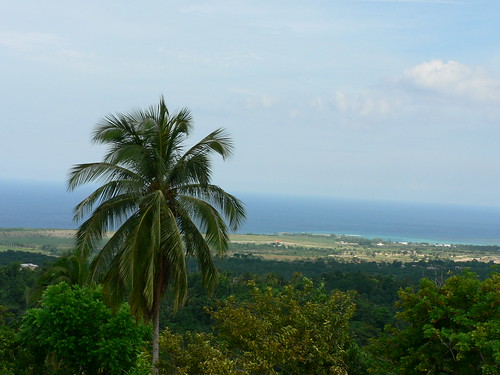
After all the excitement of the week, the weekend finds me on the north coast, in part to work (to spend time at the culminating weekend for the Burgher Gully Project) but also to relax in Mo-Bay and enjoy a little time away from the city. The drive up was a lovely as ever as I chose the north coast road that hugs the Caribbean for over three hours between St Mary and Negril, through seaside towns bustling with Saturday market activity, the sun blazing down on a turquoise Caribbean Sea. It is a very different Jamaica from the dense urban environment of Kingston. The country looks verdant and fertile with fruit and foliage. Along the route are endless fruit stands with a colourful variety of fruit an vegetables, fish stands with crab, lobster, snapper (red and grey) parrot fish and more, and of course smokey jerk stops with the tantalising smell of barbequing chicken, pork, lamb and sausage. There is no need to go hungry if you live in the country! It is lovely to sit and enjoy the breeze, the sun, the quiet and the sea and recharge for the next week in the city.
Sunday, March 27, 2011

Cloudless skies

The week has gone quickly absorbed by time at the Burgher Gully Project, 5th Caribbean Conference on Dispute Resolution planning and ending with greeting the new CUSO-VSO arrivals as five more volunteers join our growing team. The days have started with cloudless skies, a delightful beginning to each day.

The Burgher Gully Project is fast drawing to a close and I spent time with the group and with individuals this week. I am interviewing each of the youth to explore what has been the most important aspect of the programme for them, what should have been there that wasn't and what will be next.
I completed six interviews and already themes are emerging. The most important aspect appears to have been providing a safe and productive place for them to go in a community in which their alternative is hanging out on the corners. Access to adults whose focus is their best interest and whose attention is the development of additional skills for the participants is also emerging as important. We have not provided enough remedial help for reading, a critical learning for the programme as many of the youth are functionally illiterate.
Of interest to me was that of the six youth I have interviewed, five perceived themselves as having "completed" high school with either a Grade Nine high school certificate or a Grade 11 high school certificate and only subsequently discovered that this level of education was of little or no value in advancing to gainful employment given their literacy level. Of the six the one young woman I interviewed was clear and articulate about her gains. She has moved from hiding in her house and not interacting with anyone to attending every day and being ready to go and further her education. She is one of the few with CXCs (the national exam that provide "subjects") Having "subjects" is an acknowledged indicator of school success and has the potential to open some job doors. She is now feeling more confident and next week will complete application forms for various taining programmes, jobs and volunteer exeriences.
Another emerging theme is the propensity for the staff to do things for the youth as opposed to encouraging the youth to do things on their own with the support of the staff. For example the Assistant Youth Peace Facilitator has created a resume for each youth rather than getting each youth to develop his/her own resume. This is a theme I will explore with the staff as it is critical we teach the youth to take initiative and ask for support.
Taking initiative is not promoted in the education system here, with a much higher value placed on compliance, and that is a subject that could be explored from the perspective of the impact on the functioning of the Jamaican society!
I am feeling there are some clear directions in which I can re-write and improve the programme to submit for funding from UNICEF and other funders and foundations. So much to do, so little time!

The 5th Caribbean Conference on Dispute Resolution is moving forward. From months of inactivity and frustration on my part at my inability to get those committing to tasks to actually do them, the urgency of the time crunch (the conference is scheduled for April 28, 29, 30) seems to have motivated everyone. Two weeks ago I articulated my concern that we really were not going to pull this off. However, significant gains have been made this week, speakers confirmed, participants signed up, budget plan finalised, conference bags ordered,the conference team expanded. We still need 450 participant days to be paid for to cover the budget but the CEO is optimistic this will be achieved. This exercise has been the most graphic demonstration of the dissonance between my planning methodology and expectations and the DRF organisation cultural norm! It has challenged my ability sustain a facilitative role. It has challenged one of my learnings from the last eighteen months, that in Jamaica if the decision is to do something it will get done, despite all appearances otherwise and the apparent impossibility to pull it off. But the week has enabled me to retrieve my faith and I am now almost convinced we will pull this off!
Your help would be appreciated - please register at http://www.drfja.org/

Last evening was spent enjoying dinner and conversation with the new volunteers who had arrived over the last four days. They come from Ghana, Trinidad/Tobago, and the east and west coasts of Canada. Their enthusiasm and curiosity about the contribution they will be able to make to the organisations they are joining was delightful. They bring expertise in human rights, human resources, court management services and victim support. It was interesting for those of us who have been here for a while to have an opportunity to share some of our learnings and experiences, however, it was also a reminder that new volunteers are arriving because some of us are preparing to leave. I find much of my work and discussion is now framed by transferring responsibilities to others and ensuring that my transition does not impact the potential of the work to continue to move forward. As yet there is no Youth Advisor identified to assume my responsibilities, but there is a great Youth Programme team whose commitment will facilitate continuity.

Therein lies the essence of my week. Each day has started with a cloudless blue sky, unusual here as typically there are clouds amassing either over the mountains or over the sea even at the beginning of the day, in the dry season often to dissipate. The morning brings cooler air until the sun rises over the mountains, but by 7:30 as I am walking from Crossroads south east down Camp Road directly into the rising the sun it is already burning hot. The late morning and early afternoon often brings strong hot breezes that offer a little reprieve from the heat of the mid-day sun when shadows are almost non-existent The mango trees are now laden with fruit, trees that have blossomed begin to show new foliage as the summer takes hold. Birds and butterflies and mosquitoes are prolific. The fruit vendors offer bags of sweet apples, star apples, sour sop and naisberries as they wander up and down between the traffic. Every other day there is the late afternoon deluge, sometimes where I am but often in the near distance. The rain can be remarkably localised, drenching one area and missing another completely. I can frequently avoid the deluge by route or timing. I have also acquired the Jamaican habit of not going out into the rain, though not going in if caught in the rain. My umbrella returns as my steady companion, and I have acquired some skill in determining at the beginning of the day if it will be a day that brings rain or not. And as more evidence of having become a part of this wonderful place my walk to and from work always includes greetings and chats with familiar faces, often students who have been at the programme who greet me as "Auntie Jacquie" and assure me as we chat, that they are keeping out of trouble! There is much I am going to miss.

Next week I will continue with interviewing the youth at the Burgher Gully project and moving all the areas in which I am involved into transition planning. Six weeks seems little time to wrap up all that I have been involved in here, and also feels like too little time left!

Sunday, March 20, 2011

Fish Fry, funding and the future...

A diverse week, touching base with various different projects and back to the task of finding funding. Much of what I am engaged with at the moment is positioning things for the future which serves to remind me of close how it is to the time at which I will no longer live here.

Negotiations with the Ministry of Education continue. The funding for the youth programme is assured until the end of July and the discussions have illustrated that MOE has been quite creative in enabling this funding. Support has come from several people and particularly one young man at the Ministry who has diligently worked through, and continues to work through, the bureaucratic maze to make sure the funding is flowed. There are still hoops to jump through however slowly but surely the cheque is getting closer to the DRF bank account! The next disucssions are about securing funding for the integration of the programme on a long term basis.
In the meantime the programme continues to operate, with a particularly busy period for the Spanish Town programme. There is much unrest in Spanish Town at the moment with one of the gangs being very active and violent. Although the students may not be attached to the gang, the increased tension in the community increases tensions and anxiety throughout and both school personnel and students tend to be more reactive, resulting in increased incidents and altercatons and increased suspensions.
In the midst of this one of the headlines in the Gleaner early in the week when reporting on the upcoming fiscal year, reported that the largest budget cuts will be in the education budget. Reducing access to education and support for children and youth seems a very shortsighted strategy in a country that has experienced quickly increasing incidents of violence in schools, high number of suspensions and expulsions, and significantly reduced success levels in the last number of years. The government's perspective on education is critical and how it distributes its budget illustrates its priorities. Education and youth are clearly not on the agenda as a priority for the current Jamaican government.


The Parents' Places proposal for implementation is being refined by Parenting Partners Caribbean in the hopes that the government and UNICEF will continue to support the initiative having funded the development of the concept. It would be disappointing to see the tremendous work that has been invested in developing the concept go to waste for lack of support to put it on the ground. The level of commitment from the group of people who have come together over the last three months continues to be high and with a quite modest additional investment the beginning of a potentially successful approach could be made a reality so there is reason for optimism.

The computers funded as part of the Burgher Gully project arrived this week and will be one of the long term legacies of the project. The computer lab was buzzing with activity when I visited the centre and not only will this give computer access to the youth involved in the programme it will allow the Peace Centre to operate an accessible computer lab for the local community.
On Friday the Burgher Gully youth hosted a fish fry at Eastern Peace Centre to raise funds for their final retreat. The youth were responsible for planning, marketing and helping with the cooking and serving so had the opportunity to learn many skills. The fry was successful, though given the nature of the community there was a fair amount of "credit" extended as people came to the centre for their lunch or dinner! The accounting will be done next week as we meet and make plans for the final two weeks of the project and evaluate the success of the project. I am continuing to write proposals to build on the beginning the project has made and hope to submit them in the next couple of weeks.

Already one of the secondary outcomes of the project has already materialised, the Eastern Peace Centre has become an active and vibrant hub in this volatile community and the computer lab will assist in this continuing. One of the local "informal community leaders", who has a role in managing the space, is there daily endorsing the establishment of peace and supporting the youth to engage in constructive and productive community involvement.

The Manatt/Dudus enquiry continues with Prime Minister Bruce Golding currently being questioned. The level of cynicism increases as the enquiry progresses! It would appear no-one believes the truth will be told, from taxi drivers to professors, from higglers to business owners there is a consistent belief that the enquiry will cost a great deal of money, lawyers will profit, nothing will be learned or gained and no-one will be held accountable! It is, however, the number one topic of conversation and continues to be broadcast daily on radio and television.

My week ended at the 60th birthday celebration of a colleague and friend from DRF. It was lovely to be included in the celebration and to be part of the group of close friends and family gathered to recognise and honour her for the wonderful woman she is. There was much conversation about the changes that Jamaica and Jamaicans have experienced over the last 60 years, and much laughter about the outfits worn in the sixties when we were teenagers! It seems Mary Quant even influenced teenagers in Kingston and acquiring and managing mini-skirts in this very conservative country took some creativity! It was a wonderful evening and the friendship will extend well beyond my tenure here.

Next week will be focused on linking with key personnel at the Ministry of Education and a concerted effort at finalising the planning for the 5th Caribbean Conference on Dispute Resolution.

Sunday, March 13, 2011

Celebrating Women, recognising gender

Given the Centenary of International Women's Day the focus this week has been on women, but also gender. The topic promotes active and animated discussions in this country in which gender roles are so clearly defined and yet so complicated. It was a week in which I had little time at the Youth Programme as three of the five days were spent at workshops and one day was a holiday - Ash Wednesday but at the end of the week we did receive significant news from the Ministry of Education - the cheque is waiting to be picked up!

International Women's Day was celebrated with recognitions and music, stories of sadness and remarkable achievements. I started the day at the Violence Prevention Alliance Jamaica which chose to dedicate its monthly meeting to the recognition of eight women who have had remarkable impact on their communities. Each was given the opportunity to tell her story and each story was a testiment to strength, determination, quiet leadership, and the unflinching will to defeat the violence surrounding her. These are not women who have joined the traditional ranks of power and influence, they are not women whose experience is the privilege of class, the best schools and uptown connections. They are women whose life circumstances could have defeated them but didn't, who chose to respond to adversities and violence with courage and conviction often risking their own lives. Women who have clearly stated that the violence cannot continue and have committed their lives to changing their communities. I cannot do justice to their stories and lives but honour them and thank them for who they are, how they live and what I can learn from them.

The day ended at a more formal event organised by the Bureau of Women's Affairs and the team that is responsible for the most recent project at DRF - The Way Out. It was truly a celebration of women, with greetings and speeches from many, performances from community theatre groups and dancers, and supported by many incredible Jamaican artists recognising the role strong women have played in their lives. It was energising and uplifting and brought the crowd to its feet many times.

The three days spent at the CUSO-VSO Gender Workshop was time well spent. With other volunteers, representatives from CUSO-VSO Latin America and the Caribbean, and representatives from the partner organisations with which we work, the days were spent examining the effectiveness of the training and support given to deployed volunteers, the policies and practices of CUSO-VSO and the other oganisations and the balance between promoting gender equity as a visiting worker and respecting the predominant culture of the countries and organisations in which we work. The discussions were informative and challenging and the days included much laughter and learning.
The dichotomies of Jamaica are clearly evident in the gender discussion. Within the institutional power structures men are unquestionably dominant in a society whose government and attitudes illustrate an irrefutably patriarchal and paternalistic approach, however in the family no-one wields more power and influence than Granny or Mummy! It is a country in which girls are outshining boys academically at every level, leading to a tertiary distribution of gender that is 85% female to 15% male. Middle management is fast becoming dominated by women but upper management remains the domain of men. And yet in the lower socio-economic spheres women still have children in the belief that the obligations of fatherhood will ensure they, as mothers, will be economically supported despite consistent evidence to the contrary. Regardless of socio-ecomomic level many women still define themselves within the context of their relationship to a man, the absence of a consistent and ecomonically supportive male figure being seen as a failure of the woman.
It is complicated and discussions are fraught with cultural and social pitfalls but this did not seem to deter the discussions within the safety of the workshop and it was as stimulating few days.
Ash Wednesday offered an opportnity to head to the beach mid-week and spend a lovely and relaxing day with friends. We were not the only ones who felt a day at the beach was a good way to spend a holiday and it was fun to run into other friends, be entertained by music from the local community festival at an adjacent beach and watch the universality of children's play in the sand and sea!

At the end of the week we received extremely encouraging news. The Ministry of Education has prepared the cheque to support the School Suspension Intervention Programme until the end of the school year and asked to meet to develop a plan for continued partnership. At many levels this suggests good reason for optimism. The students will continue to have a safe and respectful place to go to when suspended from school and the continued opportunity to develop different strategies to resolve conflicts, the schools will continue to benefit from the approaches promoted by the Peace and Justice Centres which will contribute to institutional change in the schools, and the Youth Peace Facilitators will continue to be remunerated for their dedication to learning, teaching and supporting. The major focus of my placement here has been to institutionalise the youth programme through sustained funding, refinining the programme and broader access across the island, and the news at the end of the week suggests this has the potential to be achieved.
So I approach next week with that note of optimism and will focus on the work with the Ministry of Education and spending moretime with the Burgher Gully Project.

Sunday, March 6, 2011

Peace Week

This week is Peace Week, though for the whole month particular attention is focused on gaining peace in Jamaica, and I attended two events of a completely different nature to promote peace and an undertanding of the violence in Jamaica. I also attended events to invite funding proposals and a wonderful dance performance presented by the Jamaica Dance Umbrella, an annual event dedicated to the memory of Professor Rex Nettleford.

The first event to promote peace was at the University of the West Indies, Mona Campus and was a lecture presented by the Violence Prevention Alliance to celebrate Professor Barry Chevannes, a well-loved, respected and tremendously dedicated UWI professor who died late last year. I had the opportunity to get to know him a little when involved in planning last year's Peace Event sponsored by the Violence Prevention Alliance. Professor Chevannes tirelessly worked towards establishing peace in Jamaica through academic pursuits, through music and through every facet of his life. He was confident that Jamaica can attain peace and realise its tremendous potential. The lecture was a series of presentations from various perspectives but all reflected the optimism that Professor Chevannes demonstrated. From the story of Trench Town told by one of my colleagues at DRF showing changes over 4 years that led to no murders in the community in 2010, to a programme developed for primary school children in which those children needing the greatest support participate in an enrichment programme based on resiliency principles and delivered by volunteers, younger (university students) and older (recent retirees). The stories illustrate what can be done with community-based, inexpensive interventions and the key seems to be supporting community ownership.
The other two presentations illustrated that there is still a long way to go. The Women's Media Watch presented a powerful edudrama on the victimisation of young women and local human trafficking. Raising awareness that as a result of the informal "war" boundaries between communities young women can be moved from one community to another, even if they are in very close proximity, and ostensibly "disappear" from their families. The lecture was concluded by a presentation by Dr Elizabeth Ward, a wonderful physician who dedicates more time and energy to working on peace than seems humanly possible. As a physician, she saw the results of the violence and became determined to make a difference, not only in assisting to heal the wounds but to focus on preventing the wounds through a public health approach. She has recently promoted the use of GIS mapping to illustrate and inform how to develop prevention plans.

The second event was the Peace Advocacy Event at the Eastern Peace Centre. Through the connections of the Youth Peace Facilitator a number of well known local artistes committed their time to performing and many local schools were invited. The youth involved in the Burgher Boyz Project had spent a great deal of time and energy tidying and sprucing up the Centre for the event. Their ambition was to host a day long event that would bring students through the day and other community members into the evening. As is typical there was a huge sound system shipped in and a DJ who had also donated his time. The sound emanating from the centre attracted many people to come and explore what was going on, though the down side was that for those of us who have not yet accommodated the propensity to incredibly loud music, it was dififculty to talk with others! This was the first time the youth had developed an event and it was interesting to struggle with using it both as an event and a learning experience. We will talk about the successes and the challenges next week as they apply the learnings from this to the employment expo they will be planning for two weeks from now. I left them to continue on into the evening and celebrate bringing the community together peacefully.

The two calls for proposals for funding, one from Jamaica Social Invetsment Fund (JSIF) and the EU, the other from USAID, whilst opportunities, both illustrated some of the flaws and difficulties presented by international development funding.
The application process for the EU funds made available through JSIF is so onerous the organisations and communities for whom the funds are targeted find it impossible to meet the demands and access the funds. This has led to a significant amount of funding being unallocated with only nine months left for use of the funds. JSIF has recognised the problem however they are unwilling to modify or change the application process to enable orgnisations to access the funds.
The USAID funds are small grants for projects that will promote community policing. Community policing is an important initiative in Jamaica where the relationship between the police and civil society is far from trusting and Jamaica has the dubious reputation of having one of the highest rates of extrajudicial police killings in the world. The funding initiative is commendable, US$5000 for small and informal community groups to engage in a community policing project. The launch for this was however uptown in one of the high end Kingston hotels, an unlikely place to attract small, informal commnity groups to learn about the grants, as well the use of the money will be incredibly highly controlled with vendors and approved projects being controlled by with USAID or the local police.
The reason for the onerous processes and control of international development money is clear. Too much of the money gets wasted through corruption or mismanagement but it seems somewhat counter productive to put in measures that then make the funds inaccessible to those whose benefit they are supposed to support.

Still no formal confirmation that the Ministry of Education will fund the School Suspension Intervention Programme (the bureaucracy works slowly) but there are assurances that we do not have to be concerned and must continue to operate the programme. At one level this is not completely reassuring but to be able to continue to offer the programme is very important and the indicators positive that it will be supported at least until July.


The week ended with attending a dance performance at UWI's theatre. The theatre is a wonderfully intimate space with a huge dance stage though marred somewhat by being airconditioned to refrigeration levels! It was a fantastic performance with companies both from Jamaica and the US. In his introduction to the performance, Kenneth Ormsby, the artist in residence and a Jamaican currently based in Toronto, noted that Jamaica is rated as the fifth most artistically creative place in the world, a statistic that resonates with all one experiences here.

It has felt like a full week and my activities range far in this small city! Next week will be less far ranging as much of it will be spent attending training and planning events for gender issues and the week will be punctuated by a mid-week holiday, Ash Wednesday.

Sunday, February 27, 2011

The wrong side of the Law?

A week in which the culmination of much planning led to people coming together, but no definitive word on funding from the Ministry of Education. The guilty verdict for Buju has distressed many and the enquiry into the engaging of a US law firm to lobby in the Dudus extradition is the most watched "soap opera" in the country.

The representatives from the various organisations supporting the implementation of Parents' Places came together for their second meeting. It was extremely well attended despite the absence of reminder calls, showing the extent of the commitment the partners have in trying to get the Parents' Places on the ground. The interest in effective implementation strategies is bringing a number of people to the table and the discussions are rigorous and informative. There is an emerging recognition amongst international develoment funders as well as government ministries that simply training people as an implementation strategy has not worked and many are searching for more effective strategies to ensure the limited dollars for change and new programmes provide the greatest impact. The Global Implementation Conference in August feels timely. The meeting provided a clear set of next steps both for the long term country-wide implementation as well as for the initial and immediate implementation of the first five or six Parents' Places.

On Friday all the staff and volunteers of DRF came together for the 2nd Annual Building Organisational Capacity Workshop. The partnership between DRF and CUSO-VSO brings a signficant number of resources to DRF (currently there are 7 volunteers with at least one additional one to join in the next month). This provides many opportunities but also some challenges as it is critical for the volunteers to work as a team. Given we all arrive at different times it is hard to ensure all have the same understanding of our role in the project but the annual workshops contribute to developing a common understanding. The day was not all work but provided a great opportunity to catch up with old friends, meet new members of the DRF team and experience the talents of the team beyond their job requirements. Singing was as usual a dominant part of the day with a re-worded rendition of One Love (the Marley classic, with apolgies to Bob) to ONE TEAM, and a performance from our Flanker, Mo-Bay colleagues, The Flanker Folk, to end the day. Over 60 people attended and the level of participation in discussions and the material that came from the dicsussions suggest it was a very successful day.

The news that BUJU had been found guilty of drug and weapons charges in the US brought a strong reaction. There is concern that Jamaica's young men get targeted as a result of their reputation, and a strong sense that they do not get a fair hearing. Buju is an artiste with a very large following, seen to be one of the major performers bringing Jamaica's talent to the attention of the world and the reality that he faces a lengthy incarceration has angered many. The trial has raised many of the issues that Jamaicans must face, the reality that drugs and guns are a significant element of the lives of many young men, the impact of the inflamatory lyrics performed by Buju a decade ago and the reputation that a number of Jamaicans are preceived as ignoring the laws of the US, the UK and Canada not only in the spheres of guns and drugs but also within the context of immigration, work permits and visitor requirements. These are issues that not only affect the young men who may be involved in illegal activity but all Jamaicans who experience greater difficulty in acquiring visas and increased costs and a heavier requirement of proof of legitimacy when they wish to visit or migrate to another countries. The burden of the reputation created by the few is unfairly carried by the many.

The other major news story is the Mannatt-Dudus Enquiry which is offering great oratory but remarkably little information! The careful or simply evasive responses from those being questioned do more to confirm the skepticism and distrust generally felt about the government and politicians than offering candid even if damaging responses. No-one doubts there were attempts to ensure the links between Mr Coke and both poltical parties would be kept far from the public eye, but perhaps there was a glimmer of hope that a fresh start could be made if the truth was shared at the Enquiry. Such has not been the case.

Next week is Peace Week and I am hoping I can devote most of my time to youth programme activities, not the least of which will be pushing hard for a positive decision from the Ministry and the Peace Advocacy Event at the Eastern Peace Centre on March 4th.

Sunday, February 20, 2011

Looking beyond today

This has been a week focussed on looking beyond today, for the Burgher Gully Project, for DRF, for Parents' Place and for the Youth Programme. My week seems to have been devoted to making plans to help sustain programmes that have recently been developed or are at risk.

The Burgher Gully youth are busily preparing for their Peace event next week. I did not have enough time to spend with them through the week, not from the perspective of their need - my contribution at this point is quite unimportant - but from my perspective! It is such a pleasure to spend time with them at the Eastern Peace Centre but my time at the moment is better spent seeing if I can generate additional funds to consolidate the gains and add further capacity so I am back to proposal writing.

The 2nd Annual DRF Building Organisational Capacity Workshop will occur on Friday and Saturday next week (February 25th and 26th). The usual last minute planning is taking place, but in discussion with others the plan for the meeting has been developed and circulated, the venue secured, facilitators engaged, the resources identified and everyone invited. In addition to the planning and discussion that takes place it is the one time in the year when all those connected to DRF get a chance to come together so it is important in terms of team building and engagement. It will be good to see members of the organisation whom I have not seen since last year.

The Parents' Place initiative continues to move forward with a very helpful response from those who attended the January meeting. Much work has been done in the intervening month and our planning on February 23rd should lead to the establishment of a country wide support system to assist implementation and sustainability, as well as an interim process to support the development and implementation of five centres by March 31st. The planned network of small community-based and run parenting resource centres could be an important tool in shifting the style of parenting from one that is dependent on punishment (including corporal punishment) to one that is more aligned with better informed parenting skills.
Following last week's meetings we had the opportunity to meet with several senior staff of the Ministry of Education regarding the demise of the School Suspension Intervention Programme.The meeting was timely as the Sunday Gleaner had carried a front page article on the number of students being suspended from school! Although the refrain from the beginning of the meeting was "there is no money" the Ministry seemed more open to exploring the possibility of redirecting existing pockets of funding, but only short term. This led to a meeting the next day at which the budget and programme proposal for the next five months was presented in the hopes that at least funds for this will be found immediately. Any extension allows more time to continue to solicit longer term funds. We should hear next week whether we have a reprieve and thanks to the Gleaner for bringing the issue into the public spotlight.
The stark reality of the decisions and priorities of the Jamaican government is apparent. Jamaica has relied upon international development agencies to invest in and develop programmes for the vulnerable. However, it seems that the sustaining and further development of those programmes, however successful, is not a priority for this government. Constraints and conditions imposed by the IMF as a result of further loans are concentrating funds through tight channels and limiting the capacity of partnerships between NGOs and Ministries. Projects funded by donors whose sustainability was built on government participation are now at risk and to add to the difficulties, in the post 2008 world of international funding, Jamaica is not considered a "poor" country. The vulnerable here are increasingly dependent on their own government to take responsibility for improving the quality of life for all and it is clear that this is not a responsibility that this government is willing to fulfill. The unwillingness of the leadership, both political and bureaucratic, in Ministries such as Education and Youth to insist that children become a priority is contributing to the increasing challenges faced by schools, teachers and others whose focus is to support the healthy development of children in this country. Jamaica provides an example of what happens when those elected use the power vested in them to address their own agenda and priorities rather than sound governance and management for all.
Perhaps my frustration is heightened by the limited time left to me to contribute my full attention to working here. It is such an absorbing and exciting place to be, with so much to offer those of us that come here. Where there may be an absence of response from those in power there certainly isn't a lack of response closer to the ground and working with those delivering services continues to be completely engaging and gratifying.

Given all that is going on next week the weekend has been spent at home preparing the necessary pieces. Today however I will make time to socialise as a friend from Ontario, for whom Jamaica is originally home, is returning briefly and lunch is planned at Devon House, which will be a delightful interlude. Devon House is a lovely 19th Century House that is now open to the public It is situated at one of the busiest intersections in New Kingston but the lush lawns, wonderful old knarled and twisted trees, and quiet courtyards provide a haven of peace easily accessible to all. It is a favourite spot for a Sunday afternoon picnic or just a quiet moment to sit under tree and read.