Sunday, February 28, 2010

Event Planning but not Tasha's Birthday celebration...Happy Birthday Tasha!

One of the things that seems to be characteristic of life in Jamaica is 'events'. There are many events to celebrate, acknowledge, commemorate, communicate and they are typically well attended. They happen in parks, churches, hotels and grand houses and the process of planning is uniquely Jamaican. I have now experienced three or four planning processes of such events with attendees numbering seventy five to one thousand and all seem to be planned in the same way, last minute, casually and chaotically. Invariably the event occurs without flaw (or without flaw that anyone is aware of!) Lights, press, MCs and performers all arrive as required despite what seemed like a very cavalier approach to co-ordination. Chairs are available, food is served and always there is a sense of bringing Jamaica to the forefront be it the Ministry sponsored concert for Restorative Justice, the Violence Prevention Alliance for Peace Day or the University to celebrate the recently passed Vice Chancellor Emeritus. The approach to planning has a tendency to promote anxiety for those of us used to a highly co-ordinated, progressive approach to planning starting well in advance and punctuated by regular conference calls and check lists, but it is another learning for me - with intention, energy and a conviction to make something happen, it almost always gets accomplished however unlikely that might appear to be the day before! Should this be the method I adopt in planning the DRF Retreat? Though my conviction is unwavering I think there is still too much of the planner in me to whole-heartedly embrace this approach!


I did not travel far this week but did have the opportunity to visit the Eastern Peace Centre that is at the intersection of three communities in east Kingston. It is a wonderful space, an old entertainment centre, with outside space and inside space that has tremendous potential. A local community activist and other volunteers have invested a great deal of time to try and create a safe and neutral space at the juncture that connects these three troubled communities but funds and more support is needed. The space currently provides room for a small primary school which was busy with children learning to read and playing together. In the rooms beside the primary school there were Grade sixers bent intently over test books, being coached for the GSAT (Grade Six Assessment Test) the national test that occurs in May and will determine which high school they will be able to attend, and thus the outcome of the rest of their academic careers. A stressful time for parents, teachers and eleven year olds, particularly in communites such as the ones between which the Eastern Peace Centre is situated, where the basics such as shoes and lunch money are hard to come by and gunshots are frequently heard.
Youth in these communites are in dire need of a space that can provide a safe and constructive environment that will be an alternative to the "corners" that are the recutruiting grounds of the gangs and dons. Perhaps this will be my next proposal writing effort....


February 28th...Tasha's 22nd Birthday!
One of the few things that tempers my enjoyment of this adventure is missing Haley and Tasha. Today is Tasha's 22nd Birthday, and I do wish I was able to celebrate with her in person.
Happy Birthday Tasha!

Sunday, February 21, 2010

A Circuitous Route to Little Ochi!

Early in the week I drove to Montego Bay with the Youth Programme Manager to meet with a number of school principals and guidance counsellors. We managed to connect with three schools and visit the Peace Centre. Although the schools were very different the principals and staff shared the common trait of being remarkably caring about the students for whom they have responsiblity. They are aware of the very difficult circumstances from which the students come, and do all in their power to assist, with the frustration that it is never enough. They are truly appreciative of the help offered to the students by the Youth Programme.

The week included a statutary holiday, Ash Wednesday, a welcome break mid-week for adults and half-term for the students. Interestingly many of the students continued to attend the suspension programme, a demonsatration of the engagement of the students in the programme, and their commitment to get back to school as quickly as possible.
To take advantage of the holiday four of us decided to travel out to Little Ochi on the south coast, a local gathering spot with a great fish restaurant, thatched huts for shade on a long curving, black-sand beach and rows of beautiful and colourful fishing dories. The journey from Kingston is about two and a half hours west....or 5 hours if one drives north by mistake, which was our circuitous route!! However, as is so often the case, the mistake provided its own fantastic experience. Having recognised our error the map offered us a road that appeared to cut directly west across country and then we could head south again. As we discovered, 'road' was a bit of an over statement! It was in fact a donkey-track through the mountains, with no surface and only just wide-enough for the trusty Yaris we were driving. The views were stunning, the donkeys, laden with cane and household items travelling the track, were kind enough to pull aside to let us by, and the owners, habitants and children in the area looked awed and puzzled at the sight of a car with four white women travelling the back roads of Jamaica. One hears often of "the country" and the differences in rural Jamaica and this was truly rural Jamaica. Villages were tiny huddles of traditional Jamaican houses, there was little evidence of any schools though lots of children walking the road, rivers winding through where women were gathered doing the washing and children and teenagers were gathered to swim and splash in the pools between the mountain streams tumbling over rocks. Cultivated terraced plots clinging to the mountian-sides were possibly those carved out by emancipated slaves two centuries ago. In these plots sugar cane, bananas, cassava, potato, beans and endless other vegetables are grown. It was a happy accident we got to see this part of the country and the only problematic consequence was a flat tyre as we returned to the paved road. As is typical of our lives here, within moments a couple of young men had stopped to help, the wheel was quickly changed, we were given directions to the town we were trying to reach and instructed to stop at the tyre repair shop further down the road as we should not travel far without a spare. We found the shop and the man who owned it repaired the tyre immediately, despite a stat holiday. We were safely back on the road in the right direction and dropped down to the sea and Little Ochi forty-five minutes later
A leisurely lunch, a quiet afternoon and a long walk along the beach at sunset were delightful and we returned to Kingston without incident on the six-lane Highway 2000 having seen far more of Jamaica than we had intended, but the better for having done so.


Sunday, February 14, 2010

Water woes

The dominant topic of the week has been the escalating water crisis. With only about 3 hours of rain since the deluge at Christmas the reservoirs and water tanks that service the city are almost completely depleted. Water is 'locked off' on a regular schedule and the pressure, even when the water is on, is very low. Water is available in some areas from 4 am until 2pm daily (the schedule at my apartment), in other areas from 4 am to 10am and 4pm to 8pm alternate days and for some it is never on. Many of the Garrisons have stand pipes for water collection that are on at infrequent intervals and the lack of water increases the stress of an already too difficult existence. Schools are being closed, the university is debating what it should do and there is much grumbling but also anxiety. The trees are beginning to show the stress and many of the lower fronds of the palm trees are yellow, the mountains have great swaths of brown along their ridges and brush fires are frequent. The rainy season typically starts in May/June, which at this point seems a long way off. It is hard to imagine what will happen if water runs out completely but that scenario seems to be a distinct possibility.


Work-wise the week was busy. Monday's travels took the management team to the Westmoreland Affiliate in Savannah La Mar, the Hanover Affiliate in Lucea, the Western Regional Office in downtown Montego Bay and the Flankers Branch in a troubled township in Montego Bay. We drove through Mandeville, a lovely city set in gentle hills, then along the coast with farmland on our right and ocean on our left. From Sav we headed round the coast and through the mountains to lunch in Lucea with several very committed members of the Hanover Board. The hospitality was wonderful and the meeting productive, though not without some difficult discussions that seem typical of growing and de-centralised organisations, wherever they are. We delivered much-welcomed office equipment at a brief stop in Montego Bay and arrived at Flankers as dusk was drawing in. The community centre was full of activity, a gaggle of teenage girls (the dance group) practising on the outside stage, the local planning group just concluding a meeting, the computer lab full of students finishing off homework. It was a hub of activity in the middle of a community in which there are too many groups of young men hanging around with nothing constructive to do. We arrived back in Kingston after 11pm having driven through a dry Fern Gully and crossed the Flat Bridge with very little water running under it. We acknowledged that to cover the west of the island in one day is challenging!


The rest of the week I focussed my attention on writing a funding proposal for the Youth Programme. If it is successful it will fund the island wide expansion over the next two years. It is a large ask and an ambitious plan and I am not confident. However, nothing ventured, nothing gained so it was completed and submitted to New York before cut off time, and I am hoping there were enough noughts in the Jamaican dollar budget total!
Next week includes another trip for the Youth Programme Manager and me to Montego Bay to visit schools and spend time exclusively on the youth programme, and a holiday on Ash Wednesday!

Sunday, February 7, 2010

Christmas Trees, Coconuts and Colgate Tubes

This week was declared Restorative Justice Week by the Jamaican Government. From meetings with students and parents, writing funding proposals, to a concert in the park on Saturday night the week has been reflective of the principles of 'RJ'.
The meetings with the students, who seemed to be potentially lost boys (they appeared to be further down the road in trouble than others) were focussed on one of the fundamental tenets of Restorative Justice - taking responsibility. The discussions took time as this principle is one not quickly embraced in Jamaican culture. More often than not there are strident declarations of why responsibility lies somewhere else.
The School Suspension Intervention Programme is based on Restorative Justice principles and uses circles extensively but despite the apparent commitment, funding from the government is not forthcoming. Hence the writing of another proposal in search of funding to continue and extend the programme across the island.
The final event of the week took place at Emancipation Park - an outdoor concert with music, theatre and dance and a delightfully amusing MC who provided the audience with information about RJ as he introduced the various performances. The huge posters that decorated the stage included a Canadian flag in recognition of the shared commitment to adopt Restorative Justice. It was a lovely event.

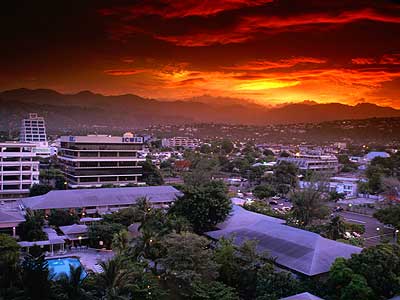
The weeks seem to be rushing by at breakneck speed and I am finding my involvement in the busy-ness of day to day activity is reducing my time for reflection. However I am safeguarding one precious time of the day, my walk home from work, most of which I do alone. It is about 6 kms from the office to my apartment past the largest, and I think oldest, army camp on the island, past the library that has provided me with wonderful Jamaican fiction to read, past the Edna Manley Arts Campus of the University of the West Indies at which there are always half a dozen young men lounging under a tree with guitars close at hand, past the banking towers owned by one of the most financially successful sons of Jamaica and a name familiar in Toronto, Michael Lee Chin. At about the halfway point I reach my first stop - the swimming pool at the Jamaica Pegasus. The pool, set in lovely gardens, is almost invariably empty. The hotel was kind enough to give the CUSO-VSO volunteers a complimentary pool pass for the year of which I am taking full advantage. I take a break in the walk and swim for a little while as the sun is setting. Then, relaxed and refreshed I finish the walk home. This is an absolutely glorious time of the day in the city. The heat and humidity of the day has dissipated and there is often a pleasant breeze. The walls and pavements hold the heat from the height of the sun and a warm glow emanates from them. The light changes from brilliant and uncompromising to soft and muted and the night flowering blossoms start issuing their heavenly scent. There is little as beautiful as sunset in a verdant tropical climate.
And now the dichotomy! Jamaica has tremendous natural beauty but this is diminished by an ever-present blight - litter. There is evidence of littering everywhere. Walking down the street yesterday provided me with the alliteration above. Christmas trees, coconuts, and Colgate tubes were but a few of the items scattered, or in abandoned piles, at the side of the street. Plastic bottles, fast food wrappers, papers, refuse: everywhere one looks there is evidence of litter. On country roads through the mountains people throw all kinds of items out of their car windows. Often it is piled but not picked up, sometimes it is bagged but left until the bags are shredded by feral dogs scavenging for food. The folliage and flora grow so quickly here that much of the rubbish is quickly hidden but more is dropped to replace it. Perhaps there are the makings of a community project here?!
Tomorrow my week will start with the DRF Management Tour of the service points - a 6 am start which will include 10 hours of driving, breakfast of saltfish and akee and stops at five different service points across the west. It will be good to be on the road again!

Sunday, January 31, 2010

The Influential Men...

This week has been one in which many of the activities I have been involved in have been focussed on developing strategies that might better protect children and interfere with the increasing violence of the youth.
Early in the week I had the opportunity of attending a community meeting at which a number of community leaders (the school principals, community pastors and a handful of others) from two "warring" communities had come together to try and develop a strategy to claim back their communities from violence. The communities together probably cover little more ground than a large city block but the stories were chilling. The discussions considered who in the communities should be involved in developing the solutions and there was consensus on the need to include The Influential Men. This is a euphemism for the Dons or gangsters, those who carry and supply the guns, recruit the youth and control the community, it feels like a pretty benign title for those who are responsible for so much destruction.

Other activities have included discussions about how to support the theme the National Child Committee has adopted for the year... All I Want is a Chance to Grow Up. In fairness most children do grow up, and many are successful. This is not a country where famine and drought or disease and war are claiming children by the thousands, but it is a country in which children die needlessly as a result of the influence of those Influential Men, a society in which the majority are stymied by the threat of a renegade minority and the consequences are infiltrating wider and deeper into the social fabric. This is manifest in the behaviour of children at school. The Manager of the Youth Programme at DRF talks about how different her experience at high school was from the experiences she is seeing now. She is 24 and left high school six years ago! In six years there has been a major shift in the schools and there is real fear that too many of the youth are out of control.
Finally, at the end of the week I attended a presentation by a sociologist and professor at the University of the West Indies (a university campus at which 85% of the staff and students is female!).The presentation introduced a predictive model for children vulnerable to failing at school and joining the gangs. I was left wondering at the value of a predictive model when there seems little political will to rein in The Influential Men.


However the week has not been all serious and work. Friends heading to Morant Bay asked me to join them and although the sea was too rough for swimming for me, good conversations and time on the beach made for a lovely day. In the evening I headed up to the foothills for a wonderful dinner of fresh kingfish and more good company, good conversation and the best rum punch in the world. The recipe is guided by an old Bajan rhyme: One of sour, Two of sweet, Three of strong, Four of weak, though the specifics kept secret by the talented producer!

Sunday, January 24, 2010

Impact and Accomplishments

When talking to my older brother yesterday, who was liming in a beautiful bay in St Lucia and yet still answering calls from his patients (he is one of those rare and valued doctors who manages to be available to support his patients wherever he is and whatever he is doing), he asked me if I felt that the things I am doing are having an impact. As well, a friend who regularly reads the blog and writes thoughtful and encouraging responses noted that there is little on my "accomplishments" here. I realised that the blog has included little detail of what I am doing and how it is going, so today I will try and fill that gap.

The overarching goal of the work each of us is doing is to increase the capacity of the organisation so that it has a sound infrastructure from which to do its work - which is to further peace and justice through conflict resolution and mediation across the island. In addition, each of us has a specific area of focus, mine is to provide support and advice to consolidate the youth programme and build a plan that will enable it to be rolled out from the current five communities to all schools across the island.

The first three months has been gathering information and understanding the context from which we were expected to develop recommendations for consideration. This phase concluded this week in a report we tabled to the DRF core management team. It was received extremely positively and generated lots of energy for forward movement, which was very gratifying and a successful first step. We now have a joint team moving forward intentionally and collaboratively which would not have been possible without our contribution. By building capacity within the organisation the work it does will have a broader reach and greater impact, and any organsation that can change the response to conflict from violence to mediation and negotiation in this society is really important. The year end statistics for murder indicate why this is important, over 1,680 murders in 2009, of which over 200 were young people under 19 years old.

Before Christmas I tabled my observations and recommendations for the youth programme and met with the team. We have together re-structured and implemented a team response to the youth and the first two weeks following the holidays has seen very positive results and again an energising of the youth peace facilitators, not the least of which are some passionate end-of-day discussions about all we would like to do in the next six months of school! I have become a regular part of the service delivery team for intake and out-take (discharge) of students, which enables me to get to know them a little and work with them indivudally about some particular struggles. The students' group discussions are still a challenge for me to understand however this week the healing circle stories of one group were easy to understand. The question asked was tell us about the worst day you can remember. Of the group almost all told of a day that included being present at the death of a friend or relative by gunfire. It is chilling to begin to understand the life of these young people, but exciting to be a part of something that may make a difference for them.

Through the work I have as a volunteer I get to do all the things I love to do: work directly with some feisty and engaging adolescents; work with service delivery teams to revise and improve what is being delivered; and work to develop systems that will increase the breadth, depth and effectiveness of a positive intervention and through this work contribute to reducing the level of violence and crime in Jamaica, and increase access to justice.

So in answer to my brother's question, this week I can answer yes. Due to the work my fellow volunteers and the staff at DRF are doing together, and the commitment of people who will be here long after me and give considerably more, I believe the contribution I am making is having an impact and accomplishing something useful! Thanks for asking...

Sunday, January 17, 2010

Judgement and Punishment

As is typical I started this blog at the beginning of the week. The process of editing and consolidating that I do at the end before posting has been particularly challenging this week given what I had started with.

Sunday night provided the first experience of "weather" I have had in Jamaica. Powerful winds and driving rain meant a sleepless night as everything inside and outside my apartment appeared to be banging and crashing, creaking and moving. It was an impressive display of what nature can do and a reminder that the weather here is not always benign. It made my thoughts turn to hurricane season and how quickly things can change as a result of a natural event. By morning all was calm, though somewhat colder than usual.
A night of wind and rain, however extreme at the time, has obviously paled in light of the event of Tuesday in Haiti. I was walking home at the end of the day when I received a call from the CUSO-VSO Programme Manager checking to see if I was alright. I had not heard of the earthquake at that point and had not felt it on the busy, noisy street but it had been felt throughout Kingston by those in buildings. The call is part of the safety protocol used by CUSO-VSO in caring for its volunteers, voice to voice contact must be established in certain circumstances. It is a reassuring process. It also illustrated how quickly events in one of these island nations affect the others, and although each is different much is shared in common.

The earthquake in Haiti has been the focus of discussion this week. For Jamaica it has raised anxiety about the advent of another major earthquake here. It is over two hundred years since the last major quake submerged the then capital of the country, Port Royal. In 1692 the city was lost , and almost all in it, as a result of a major earthquake. The ruins of the city are still visible beneath the waves. People wonder if another earthquake is due here and if the activity in Haiti will cause further instability in the area. The fragility of this lovely environment seems palpable.
Conversation at our Friday staff meeting was about what can be done to help Haiti, and how to make preparations at home.

In addition to what help can be offered, the other major theme of discussion regarding the earthquake, so closely on the heels of three major hurricanes (2008), in Haiti is about why. Jamaica is a country in which Chrisitianity is deeply embedded. Prayers start most meetings and gatherings, Devotion starts every school day and reference to the bible is frequent and reflects a quite literal interpretation. The question many seem to ask is: "Has the wickedness in Haiti brought the judgement of God?" There is a view that Haiti has let "wickedness" grow strong and flourish and by doing so is now vulnerable to the judgement and punishment of God. There is also a concern that God will judge Jamaica's response to Haiti, and that this is an opportunity for Jamaica to show compassion to those who have embraced wickedness, or perhaps a need to show compassion to ward off the potential of punishment here.
This response has raised my consciousness of how judgement and punishment are integrated into the way of life in Jamaica, it is something to which I will give greater thought.

As I look out over the green, lush view toward the mountains and the sun rises on a quiet Sunday morning it is hard to accept that others, not far from here, are living in abject poverty and constant struggle, and that even then events occur than can make their lives, impossibly, more horrific. I do not believe judgement and punishment is a useful perspective. Hope and compassion strike me as offering a better future. However, courtesy and etiquette will restrain me from sharing this opinion in most discussions here, and that is a topic for another entry!

Regardless of judgement or punishment Haiti is foremost in the prayers and thoughts of all here and whatever support can be offered will be generously provided.